A game-changer for Wellbeing Leads: Mental Health First Aid Workplace Risk Assessment

Lara
Wrote this on, September 18, 2025
The first of its kind
For years, organisations have invested in Mental Health First Aid and Champion networks to support employees. These networks were designed to create peer-to-peer support, offer a lifeline to colleagues in need, and show visible commitment to mental health.
Yet a critical question remains unanswered.
How safe, effective and sustainable are these networks?
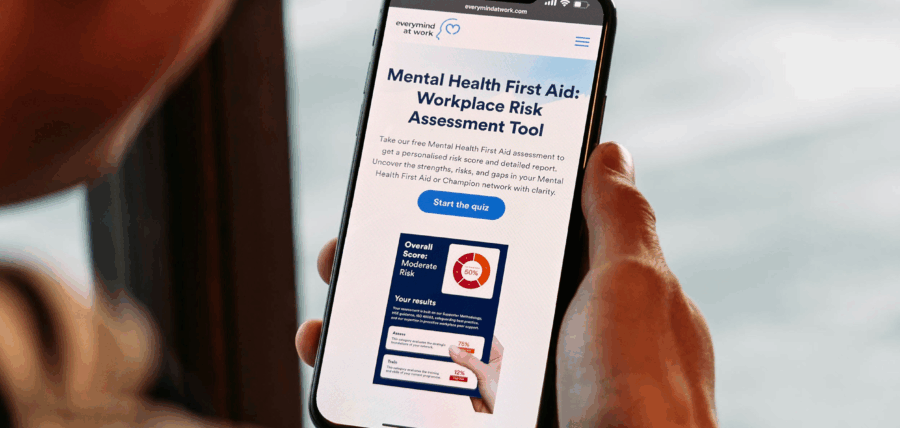
The Mental Health First Aid Workplace Risk Assessment tool is the first of its kind. It gives clarity and confidence to HR, wellbeing and health and safety leads. For the first time, they can measure the true effectiveness of their network and identify areas of risk before they cause harm.
Why this matters now
Mental health is now a central focus in the workplace. Employees expect support to be genuine, structured and proactive. At the same time, the Health and Safety Executive is strengthening its advice on psychological health, and new regulations are expected to place even greater responsibility on employers.
Despite this, many leaders admit they do not know how well their Mental Health First Aid or Champion networks are performing. Some worry about visibility. Others question whether safeguarding and escalation processes are clear. Many simply do not have data to prove impact or protect against liability.
Without answers, businesses are exposed. The [workplace risk assessment tool] changes this. It replaces uncertainty with evidence and turns good intentions into sustainable practice.
Built on proven frameworks
The assessment is built around Everymind’s Supporter Methodology:
Assess: identify strengths and weaknesses with clarity
Train: provide consistent skills and safeguarding knowledge
Support: reduce burnout through structured backing
Engage: increase visibility and trust among employees
Measure: track outcomes and adapt as the business evolves
It is also informed by ISO 45003 standards, safeguarding best practice and the latest HSE guidance. For health and safety leads, this ensures the tool aligns with recognised frameworks and evolving legal expectations.
What the assessment provides
Organisations that use this assessment tool receive a personalised risk score and a detailed report. Within this, leaders will see:
where networks are exposed, for example through low visibility or reactive-only support
the strengths that can be celebrated and scaled
clear, actionable recommendations to close gaps and build resilience
Instead of assumptions, HR and wellbeing leads gain reliable insight into how their network is really working.
The cost of not knowing
Without assessment, risks remain hidden.
Employees may not know who the Mental Health First Aiders are, leaving networks invisible.
Support may only appear during a crisis rather than preventing issues earlier.
Safeguarding processes may be unclear, putting employees and supporters in difficult situations.
Champions may burn out without structured support.
Organisations may fall short of HSE advice or upcoming regulations, leaving them exposed.
These are not abstract risks. They are already happening in workplaces. The difference is that they can now be identified and addressed.
Why it matters for HR, wellbeing and health and safety
For HR, the tool finally provides data that can be shared with senior leaders. For wellbeing professionals, it offers direction on where to focus efforts. For health and safety teams, it aligns mental health with the same structured approach used for physical safety.
In each case, the assessment builds confidence. Leaders can see clearly that their networks are not only visible but also effective, safe and sustainable.
Moving from initiatives to impact
Too often, wellbeing programmes risk becoming symbolic. They may launch with good intentions but struggle to demonstrate impact. Without measurement, networks remain vulnerable to stagnation.
The workplace risk assessment tool helps avoid this. By identifying risks, strengths and practical steps forward, it ensures networks evolve into something embedded and proactive. This is not about ticking boxes. It is about creating a culture of support.
Looking ahead
Work is changing. Employees expect authentic support. Regulators are sharpening expectations. Businesses that do not adapt risk reputational and legal consequences.
The launch of this tool represents a new standard. It treats mental health with the same seriousness as physical health and financial controls. It gives leaders the evidence they need to act with clarity and confidence.
The Mental Health First Aid workplace risk assessment tool is the first of its kind. It aligns with HSE advice and upcoming regulations, giving leaders the data to protect employees, support culture change and reduce organisational risk.
By turning assumptions into insight and risks into clear actions, it ensures that Mental Health First Aid networks can truly deliver on their promise. For HR, wellbeing and health and safety leads, it is nothing short of a gamechanger.